
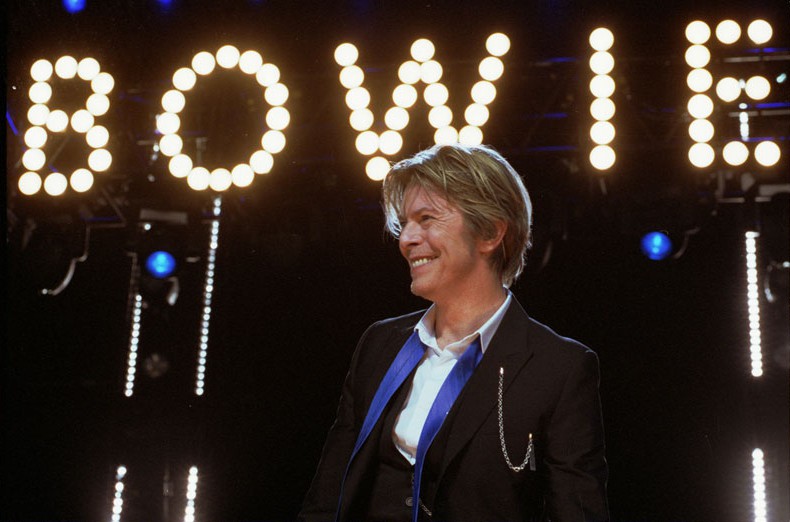
David Bowie’s queerness is most closely associated with his music, but how does it manifest in his film career? James Gent offers a whirlwind retrospective.
David Bowie’s extraordinary musical career contained multitudes. No mere entertainer, his creative restlessness and appetite for reinvention saw him adopt a number of guises and fusings of genres. He was also, for a period in the 1970s, Ziggy Stardust, a pansexual, androgynous, alien rock god.
Ziggy was the androgene – masculine and feminine, ambisexual, “A Clockwork Orange in Liberty silks” in his creator’s words, flawed Earthling and untouchable extraterrestrial.
Bowie’s (or was it Ziggy?) admission of bisexuality in Melody Maker was a ground-breaking and controversial revelation at the time. To his new audience, Bowie’s provocative press statements, androgynous glamour and the homoerotic nature of his songs presented sexual experimentation as something attractive, exotic even, rather than a hotbed of hang-ups. He was not the first star to shake things up by queering rock’s innate heteronormative conservatism, but it was a sign of the times, in tune with the rise of gay, feminist and civil rights movements.
It’s still a matter of debate as to what extent his ‘coming out’ was a calculated publicity stunt, and to what extent his stated bisexuality was merely a ‘pose’. What is undeniable, however, is that Ziggy gave young fans becoming aware of their own sexuality, along with anyone who felt like a social misfit, a sense of identification and feeling of liberation.
To his new audience, Bowie’s provocative press statements, androgynous glamour and the homoerotic nature of his songs presented sexual experimentation as something attractive, exotic even, rather than a hotbed of hang-ups.
Queer themes are less prevalent in his parallel career as an actor, but just as in many ways, Bowie was an unconventional rock god, as happy to don a flowing pre-Raphaelite gown on an album cover as an Armani suit, his choice of film roles were no less unconventional by mainstream Hollywood standards.
Auteur Nicolas Roeg’s The Man Who Fell To Earth provided his first lead role in a major motion picture. David Bowie was perfectly cast as the cold, detached alien, who builds a booming technological empire, in order to fund a secretive space travel project.
Due to his lifestyle and a diet that consisted exclusively of milk, peppers, and weapons grade Colombian marching powder, Bowie cut an anorexic figure. With his alabaster-white skin and thatched crown of vermillion hair, Anne Rice appositely compared Bowie’s character with that of the androgynous Katharine Hepburn in the cross-dressing romantic comedy Sylvia Scarlett.
After a three-year hiatus, Bowie returned to the music world in a big way with 1983’s Let’s Dance. A deliberate attempt to reposition himself firmly in the musical mainstream, his comeback was accompanied by not one but two major film roles.
Based on Laurens Van Der Post’s novel The Seed And The Sower and directed by Nagisa Oshima, Merry Christmas Mr Lawrence was the tale of Allied soldiers in a Japanese prisoner of war camp, with Bowie playing Major Jack Celliers. One of the film’s main themes is the repressed homosexual desire of Celliers’ captor, Captain Yonoi (Ryuchi Sakamoto), towards the resolute, defiant Celliers. Yonoi initially takes an interest in Celliers when he takes off his shirt in the courtroom to provide evidence of his torture at the hands of the camp’s soldiers. Eventually, Celliers seals his fate when he breaks rank and kisses Yonoi on the cheek in front of his soldiers, an unbearable violation of Yonoi’s code of honour.
In sharp contrast to Merry Christmas Mr Lawrence’s arthouse credentials, Bowie’s other cinematic offering of 1983 was The Hunger, a glossy, stylised erotic vampire thriller directed by the late Tony Scott, Ridley Scott’s younger brother. All neon strip lighting, dry ice and billowing silk curtains, it’s basically a full-length 1980s MTV video. It’s mostly remembered for three key scenes: Bauhaus performing ‘Bela Lugosi’s Dead’ in London’s gay nightclub Heaven, while the stars (David Bowie and Catherine Deneuve) stalk the crowd for fresh meat; the sequence in which Bowie proceeds to age 200 years in the space of an afternoon; and a seduction scene between Catherine Deneuve and Susan Sarandon, accompanied by the strains of Lakme’s Flower Duet. Pure ‘lesbian chic’ in the vein of such ‘70s softcore erotica as Bilitis and Laura: Shadows of a Summer.
As the ageless vampire Miriam, Deneuve’s character is a callback to Sheridan Le Fanu’s creation, Carmilla. Influenced by ‘blood countess’, Elisabeth Bathory, Carmilla explored lesbianism and female sexuality and inspired Hammer horror film The Vampire Lovers starring Ingrid Pitt. The Hunger itself has a legacy of sorts, belonging to a then-small niche of “modern day vampire” films such as Martin (1977), Vamp (1986), Near Dark (1987) and The Lost Boys (1989).
As the ageless vampire Miriam, Deneuve’s character is a callback to Sheridan Le Fanu’s creation, Carmilla. Influenced by ‘blood countess’, Elisabeth Bathory, Carmilla explored lesbianism and female sexuality and inspired Hammer horror film The Vampire Lovers starring Ingrid Pitt.
Perhaps Bowie’s most infamous role was Jareth, King of the Goblins, in Jim Henson’s musical fantasy, Labyrinth (1986). While it was not a huge commercial success, and received rather sniffily by critics, it has enjoyed a prolonged cult following, acting as a gateway drug for countless Generation X and millennial Bowie neophytes over the years.
A film for children of all ages, there are some dark, complex themes lurking beneath its’ Muppety surface, firmly in the same tradition as European fairy tales and turn of the century fantasy fiction, noted for their darkly moral messages and sexual undertones. Essentially, the film is about the world’s worst babysitter, Sarah (played by Jennifer Connelly), a teenage girl on the cusp of womanhood. Jareth’s ensnaring of Sarah’s baby is initially the classic fairytale trope of “Be careful what you wish for!”, but over time it becomes clear – or as clear as a PG rated film can be – that the challenges and pitfalls that Jareth places in Sarah’s path as she crosses the Labyrinth are a ruse to trap Sarah and seduce her as his Queen.
At times, the subtext isn’t particularly sub, such as when Sarah bites into a charmed peach (echoes of the temptation of Eve, and Snow White’s poisoned apple) and, hallucinating, finds herself in a sumptuous masqued ball, surrounded by decadently costumed revellers, and serenaded by Jareth. Here, Jareth represents seduction, temptation and the pleasure principle, the masquerade an entrée into a sensual adult world. She breaks the spell, and in the climactic confrontation, Sarah rejects Jareth’s dominion, returned back to the safety of her bedroom, surrounded by her stuffed toys and picture books. Effectively, her sexual awakening has been forestalled, and childhood innocence can continue for another day, uncorrupted. Connelly proves herself an accomplished young actor, but it’s Bowie, clearly relishing the role’s pantomime aspects, who steals the show – although it’s arguable that his well-stuffed leggings deserved a joint credit.
Connelly proves herself an accomplished young actor, but it’s Bowie, clearly relishing the role’s pantomime aspects, who steals the show – although it’s arguable that his well-stuffed leggings deserved a joint credit.
As Bowie grabbed back the reins of his career in the ‘90s and the new millennium, his film roles dwindled down to bit parts and cameos. Notable appearances include John Landis’ Into The Night (1985), Martin Scorcese’s The Last Temptation of Christ (1988), Twin Peaks: Fire Walk With Me (1992), Everybody Loves Sunshine (1999, as a gay gangster), Zoolander (2001) and The Prestige (2006).
The film world is littered by good, bad and mediocre performances by “singers who can act a bit”, but Bowie’s intriguing choice of roles and unique visual appeal made his movie career variable, but rarely dull, another manifestation of his role playing and adoption of multiple masks.
Follow James on Twitter (@jamesgent76)
See more on Film from The Queerness here.


One thought on “Hooked to the silver screen: David Bowie on film”